Dealer vs Private Seller vs Marketplace: Buying a Used Car in Hickory Safely
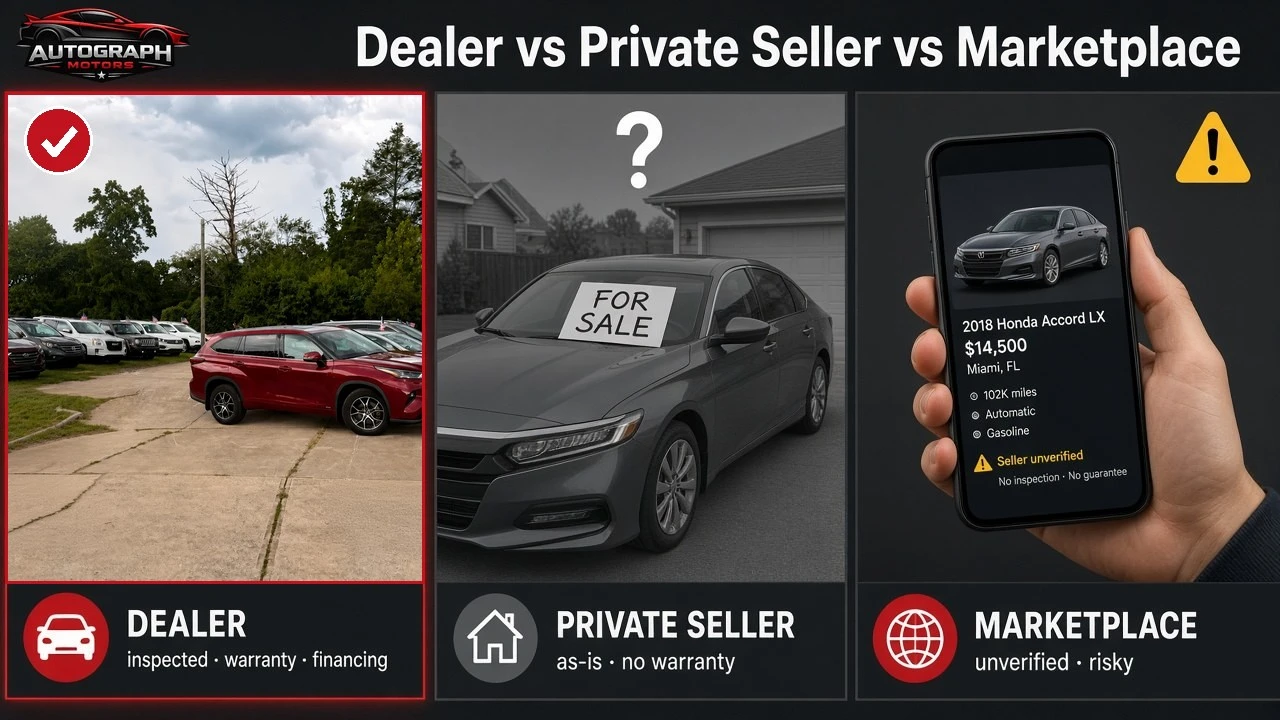
Somewhere between a lunch break and a late-night scroll, most Hickory shoppers end up with three tabs open: a used car dealers near me search, a neighbor's sale post in a community group, and a Facebook Marketplace listing that looks almost too clean. All three show cars for sale. They are not three versions of the same purchase. Each one hands you a different set of paperwork, a different amount of recourse, and a different share of the risk.
This guide walks through what each channel actually asks of you, what North Carolina law requires in a private sale, and the warning signs that keep showing up in online listings. For most buyers, the answer points to the same place: a licensed dealer that carries the paperwork, the disclosures, and the accountability so you do not have to. If you want to see what is on the ground right now, the Autograph Motors inventory is open while you read.
Three ways to buy, three different jobs for you
Think of every used-car purchase as a bundle of tasks: finding the car, confirming it is what the ad says, proving the seller owns it, settling the price, moving money, transferring the title, getting plates, and living with whatever surfaces in month two. The channel you pick decides how many of those tasks you carry personally.
- Licensed dealer. The lowest-risk route for most people. The business is licensed by the state, posts a federal disclosure on each window, can collect the tax and handle the title and tags, and has a physical address you can return to after the sale.
- Private seller you know. A coworker or a relative of a friend. You may learn something about the car's history, but every remaining task, from the notary to the plate agency to the inspection, lands on you, and the sale is normally final the moment you sign.
- Online marketplace stranger. Facebook Marketplace, Craigslist, OfferUp. Also a private sale, except you usually cannot verify who is behind the profile. This is the channel where federal agencies report the most fake vehicle listings.
The difference is not the car itself. It is who is responsible when something about the deal goes wrong.
What a licensed dealer has to do that a neighbor does not
In North Carolina, anyone who sells five or more vehicles within any 12 consecutive months for money is treated as a motor vehicle dealer under G.S. 20-286, and a dealer license is required before doing that business. Licensing means the state knows where the lot is and who runs it.
Federal rules add another layer. The FTC's Used Car Rule requires dealers to display a Buyers Guide on each used vehicle they offer. That sticker states in plain language whether the car is sold with a warranty or "as is," reminds you that spoken promises are hard to enforce, and tells you to get commitments in writing. Private individuals generally are not covered by that rule, so a neighbor's listing comes with no such form at all.
Dealers in North Carolina can also collect the highway-use tax and apply for the title on your behalf, which is why buying from a lot usually ends with you driving off already covered rather than standing in a plate agency line. For a deeper look at what that final number contains, our walkthrough of the out-the-door price at a Hickory dealership breaks down each line.
A good habit at any lot: ask for the warranty, service-contract, and return terms in writing, and keep them with your Buyers Guide. A licensed dealer can put those terms on paper and stand behind them from the same address next month.
Why a licensed dealer is the safer, simpler choice
Price is only one part of a used-car purchase. The rest is verification, paperwork, money handling, and what happens if a question comes up after you drive home. That is where a licensed dealership earns its place.
- A known, licensed business. You are buying from a company with a state dealer license and a street address in the community, not a profile name that can disappear overnight.
- Written disclosures on every car. The Buyers Guide tells you up front whether a vehicle comes with a warranty or is sold as-is, so there is no guessing about what was promised.
- Cars prepared before they are listed. Dealers commonly inspect and recondition vehicles before they reach the lot. Ask what was checked or replaced on the car you like and request it in writing.
- Clean title work. The dealer verifies ownership and liens, handles the title assignment, collects the highway-use tax, and can get your registration and tags started, so you are not hunting for a notary on a Saturday.
- Financing and trade-in in one visit. Instead of saving the full price in cash and then running a separate private sale for your old car, you can handle the loan, the trade, and the purchase at one desk.
- Someone to call after the sale. If a paperwork question or a concern comes up, you know exactly where to go. Licensed dealers are also regulated by the NC State Highway Patrol's Investigative Services Unit (formerly the DMV License and Theft Bureau), which takes consumer complaints about dealerships.
A private sale can work out, but it asks the buyer to do all of this personally and usually leaves no recourse once the money and title change hands.
North Carolina paperwork when you buy from a private party
This is the part people skip, and it is where most private-sale headaches start. According to the NCDMV title transfer page, both seller and buyer complete the back of the title, and if the original is a North Carolina title, the seller's signature must be notarized. The assignment includes the buyer's name and address, the date of sale, the seller's signature and hand-printed name, an odometer reading when required, and a damage disclosure statement.
What that means for a Hickory buyer going the private route:
- Find a notary. A title signed at a gas pump with no notary is not finished.
- Check the title against the car. The VIN on the title should match the dash and the driver's door jamb, and any lienholder listed on the front needs a written release.
- Watch for alterations. The NCDMV title manual notes that an altered assignment is void. White-out, scratched names, or a second handwriting on the buyer line are reasons to stop.
- Plates stay with the seller. Under G.S. 20-72, the owner removes the license plates when transferring a vehicle. You will need your own registration and plate, plus North Carolina liability insurance before a plate is issued.
- You have 28 days. G.S. 20-73 requires the new owner to apply for a title within 28 days of the transfer. Missing it brings a $20 civil penalty and can be charged as a misdemeanor.
- Budget for the highway-use tax. North Carolina charges a 3% highway-use tax when a title is issued instead of a regular sales tax. On a private sale, state law bases it on the vehicle's market value from the DMV schedule, not only the price you negotiated, so a "steal" may still be taxed at book value.
Buy from a licensed dealer and this list becomes the dealer's job. The title assignment, tax collection, and title application are handled as part of the sale, and you sign where you are told to sign.
Marketplace red flags that show up again and again
Facebook Marketplace is where most local private listings live now. It is also where federal agencies keep seeing the same playbook. The FTC and the FBI's IC3 both describe fake listings for vehicles the poster does not own or possess. The patterns repeat closely enough that you can learn them in five minutes:
- A deposit before you see the car. "Send $300 to hold it" through Zelle, Cash App, or a gift card. A real seller can wait until you are standing next to the vehicle.
- Gift cards or wire transfers for any part of the price. The FTC is blunt: if anyone tells you to pay that way, it is a scam, every time.
- A story that blocks inspection. Military deployment, a divorce, a relative who passed, a job transfer. The car is "already at a shipping company" and will be delivered after payment through a "buyer protection program." Legitimate marketplaces do not run vehicle escrow through a link a stranger texts you.
- The title is not in the seller's name. "It's my cousin's," "I bought it and never switched it over," or "the title is coming in the mail." In North Carolina the person signing the assignment has to be the titled owner, with a notary watching.
- Several cars, one phone number. If the same profile keeps posting different vehicles, you may be dealing with a curbstoner: an unlicensed person flipping cars as a business while presenting each as a personal sale. Regularly selling five or more in a year without a license is exactly what North Carolina dealer licensing is meant to prevent, and those cars often carry hidden flood, salvage, or odometer problems.
- A price far under every comparable listing. Scam ads are built around the number that makes you stop scrolling.
If you do look at a private listing anyway, run the VIN through the National Insurance Crime Bureau (NICB) VINCheck tool, which is free and flags vehicles reported stolen or as salvage by participating insurers, meet in daylight in a busy public place, and never pay before a signed, notarized title is in your hand. None of those steps are needed when the seller is a licensed lot with its name on the building.
Comparing the real cost, not just the sticker
A private listing may show a lower number than a comparable car on a dealer lot. That gap usually narrows fast once you add up what the dealer price already includes and what a private buyer pays for separately:
- Inspection and reconditioning. On a private car, the pre-purchase inspection is your bill, and so is anything it finds. A dealer car has typically been checked and prepared before listing; ask what was done, in writing.
- Immediate repairs. Tires, brakes, or a battery that a private seller left for the next owner come straight out of your pocket in the first month.
- Your time. Notary, plate agency, insurance, and inspection visits add up to days, not hours.
- Financing. Most private sellers want the whole price at once. A dealership can often arrange a loan in the same visit, which opens the door for buyers who cannot pay cash. Our financing page explains how that works here.
- Trade-in. Selling your current car on your own is another full private sale with its own risks. A dealer can fold your old car into the deal; see how that works on our trade-in page for Hickory drivers.
Put those pieces next to each other and the difference often shrinks to a small amount, which buys written disclosures, handled paperwork, financing access, and a business that is still there after the sale. Compare totals, not headlines.
A quick decision guide for Hickory buyers
Why a dealership fits most Hickory buyers
- You need financing, want to trade in your current vehicle, or both
- You want the title, highway-use tax, and plate work handled in one sitting
- You prefer a Buyers Guide, a business address, and written terms you can point to later
- You want a car that was looked over before it was listed
- You would rather not spend weekends meeting strangers across Catawba County
Walk away from any seller if
- Money is requested before you see the car
- The title is missing, altered, or in someone else's name
- An independent inspection is refused
- The story keeps changing
Shopping used cars in Hickory NC with a local dealership
Autograph Motors is a licensed Dealership Hickory NC drivers can visit in person, where every vehicle carries its Buyers Guide and you can ask every question in this article face to face. Start with our used cars in Hickory NC page or browse the full selection of cars for sale. If you want to know your payment options before you visit, check our financing page, and when you are ready to see a car or talk through a trade, reach out on our contact page. We will handle the paperwork so you can focus on choosing the right car.