
How to Test Drive a Used Car: A 20-Minute Hickory Route That Reveals Real Problems
A lot of used-car shoppers treat the test drive like a formality. They start the engine, roll around the parking lot twice, and decide they like the way the seat feels. That kind of loop almost never shows a weak transmission, a vibration that starts at 65 mph, a cooling system that only acts up on a grade, or a rattle that appears on broken pavement. Those problems wait for real roads.
In Hickory, you can build a tighter test drive checklist around the same roads you already use. From Autograph Motors at 264 21st St SE, a 20-minute loop can cover city streets, a short stretch of I-40 or US-321, a hill, a rough patch, and a parking lot for slow maneuvers. This guide is about that drive: what to do before you turn the key, what to listen and feel for on each segment, what to recheck when you get back, and what to ask the seller. It is not a full pre-purchase inspection, and it is not a paper-history lesson. Those jobs have their own pages. This one is about time behind the wheel.
If you are scanning used cars near me or comparing Used Cars Hickory NC listings, plan this route before you visit so you are not improvising in the lot.
Why twenty minutes on mixed roads beats a quick lot loop
Modern cars can hide a lot in first gear at 10 mph. Automatic transmissions often feel fine until they have to hold a gear on a grade or kick down on the interstate. Wheel bearings and tire problems stay quiet until a certain speed. A slightly dragging brake may not smell until you have used it through a string of lights. A loose heat shield or worn stabilizer link may only announce itself when the pavement gets choppy.
Twenty minutes is long enough to change speeds, change surfaces, and let fluids and brakes warm up, without turning the appointment into a road trip. The point is not the clock. The point is to give each system a job it cannot fake on a flat parking lot.
Before you turn the key: the cold-start check
Ask that the vehicle sit until you arrive. A seller who has the engine already warm is not automatically hiding something, but a cold start is more honest. You want to hear how long the engine cranks, whether the idle settles cleanly, and whether any warning lamps linger after they should go out.
Before you start it:
- Walk a slow circle. Look under the engine and transmission for dark spots on the pavement, and glance at the inner edges of the wheels for heavy dust or fresh drips.
- Check that the tires look evenly worn and that none is obviously low. You will learn more about them on the rough patch and at highway speed, but a soft tire will distort everything else you feel.
- Sit in the driver's seat and set it the way you would for a commute. Adjust the mirrors. Make sure you can see out of the corners and that the wheel, pedals, and shifter fall to a natural place. If you cannot get comfortable in the first minute, that matters as much as any mechanical note.
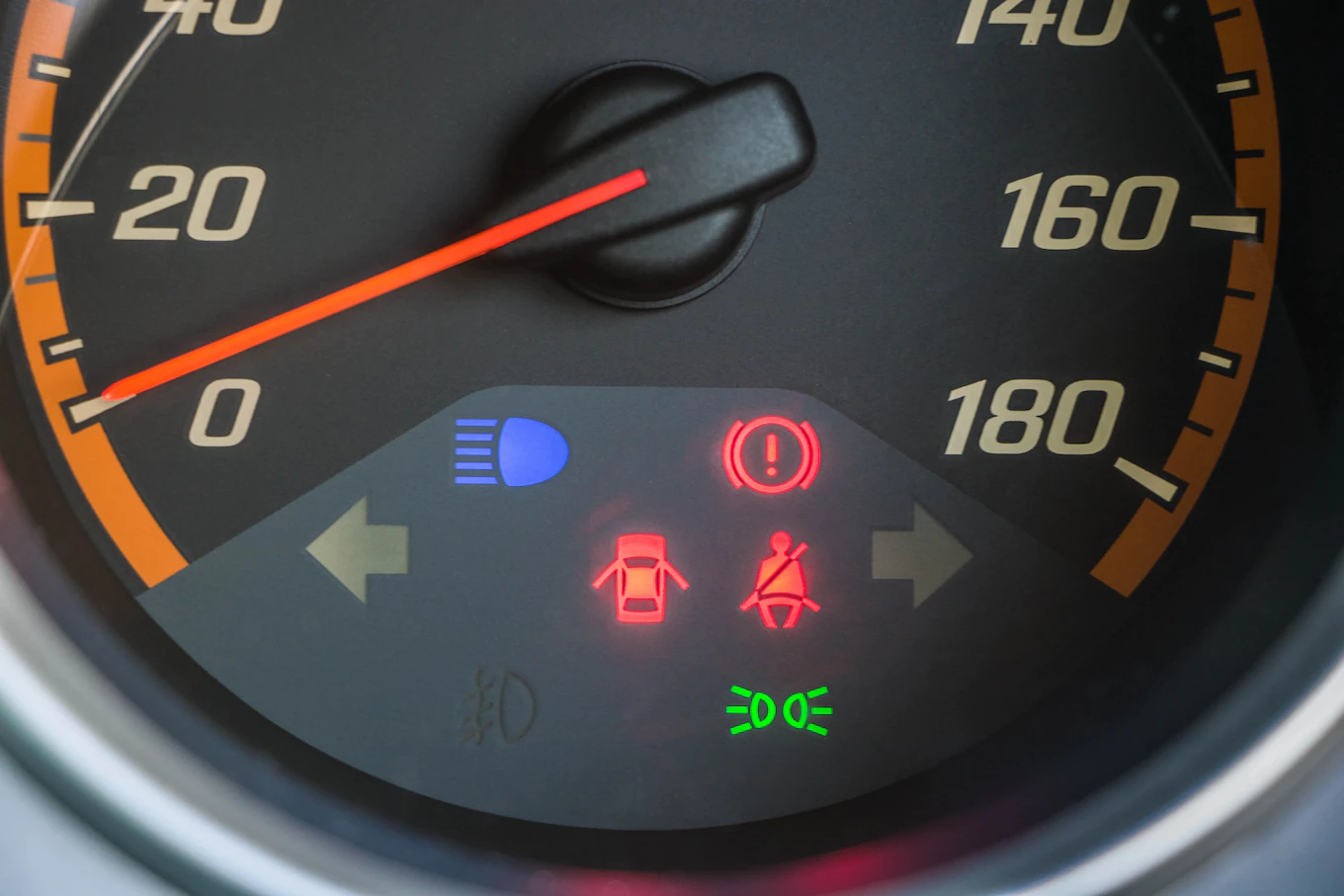
- Turn the key to the "on" position, or press the start button halfway if that is how the car works, and watch the cluster. Lamps should come on, then clear. Note anything that stays lit.
Now start the engine from cold. A healthy gasoline engine should fire within a couple of seconds and settle to a steady idle without a cloud of blue or white exhaust after the first moment. A brief puff on a cool morning can be normal. A lasting cloud, a raw fuel smell, or a rhythmic shake in the steering wheel or seat is worth writing down before you move.
Listen with the windows down for a few seconds: ticking that fades as oil pressure comes up is common on some engines; a sharp knock, a squeal that does not stop, or a grinding from the front of the engine is not. Confirm the climate control blows air, the defroster works, and the lights, wipers, and horn respond. Then release the parking brake, ease into gear, and roll a few feet in the lot. The first engagement should not bang or flare. If you feel a delayed lurch, stop and note it before you reach the street.
Bring a passenger if you can. One person drives. The other watches the temperature gauge, listens, and writes.
A 20-minute Hickory loop you can actually run
You can start this loop from Autograph Motors on 21st Street SE, or adapt the same ingredients from another lot in town. The idea is a mix of road types, not a turn-by-turn script you have to follow at the expense of safety or traffic. Stay in posted limits, signal early, and skip any segment that feels too tight for the moment.
A practical split looks like this:
- About five minutes on city streets
- A few minutes on a busier arterial such as US-70
- Six or seven minutes at highway speed on I-40 or US-321
- A hill or rolling grade
- A rough patch or railroad crossing
- Three or four minutes in a large parking lot for slow maneuvers
City streets around 21st Street SE
Leave the lot and use 21st Street SE and the nearby surface streets. This is 25 to 35 mph driving: stop signs, short straightaways, right and left turns, and the kind of low-speed work you do in a Hickory neighborhood.
On this segment, pay attention to:
- Takeoff from a stop. The car should move off without a shudder through the wheel or seat. On an automatic, first-to-second should be smooth. On a manual, the clutch should take up in a predictable place and should not chatter or smell after a few starts.
- Tight turns at walking-to-neighborhood speed. A rhythmic click from a front corner on full lock often points to a CV joint. A moan from the steering can be a pump or fluid issue.
- Brakes at low speed. The pedal should feel firm and the car should stop straight. A pull, a scrape, or a pulsing pedal this early is a problem, not a later maybe.
- Steering on-center. Even at 30 mph, a car that wanders or needs constant correction is telling you something about alignment, tires, or play in the front end.
- Cabin noises over ordinary seams. A single tick from a loose interior piece is one thing. A knock from underneath on every small bump is another.
Do not ride the brakes to "test" them. Use normal stops, then one slightly firmer stop in a safe, empty stretch if traffic allows.
Arterial traffic on US-70
From the southeast side of Hickory, it is a short run toward the US-70 corridor, where lights are closer together and speeds are often around 45 mph. This is the kind of driving many people do between errands, the mall area, and work.
Repeated stops in closer traffic will warm the brakes. If the pedal grows longer, if you smell a sharp hot-liner odor after only a handful of lights, or if the car begins to pull, give that more weight than a single soft stop on a side street. Watch the temperature gauge as the engine works through slower traffic with the air conditioning on. The needle should stay in its normal range. A slow climb toward the hot end, especially with the A/C on, is a reason to ease off and look at the cooling system later.
This is also a good place to try a passing-style downshift in a gap you already have, not a risky move: a brief, firm press on the accelerator should produce a clean kickdown, not a pause and then a surge.
Highway speed on I-40 or US-321
From this part of town, I-40 is close, with ramps at Lenoir Rhyne Boulevard and McDonald Parkway only a few minutes from 21st Street SE. US-321 is the other useful option, especially if you are already on the west side of Hickory. You only need a few miles: a clean merge, a stretch at 60 to 70 mph, one relaxed lane change, and a smooth deceleration.
At speed, new problems show up that city streets will not reveal:
- Vibration in the wheel, seat, or floor that appears in a narrow speed band and fades again often points to a tire, a wheel balance issue, or a worn driveline component. Note the speed where it starts.
- A humming or growling that rises with speed can be a wheel bearing or a tire. A hum that changes when you gently drift in the lane, changing the load on each side, is a useful clue.
- The car should track straight without a constant lean on the wheel. If it wanders in a groove or feels nervous in a light crosswind, write that down.
- Wind and road noise should be present but not exhausting. A whistle from a window or sunroof seal, or a roar that makes conversation hard, is worth comparing with another car the same day.
- Watch the temperature gauge after the merge and again after a few minutes at cruise. Some cooling problems stay hidden until airflow and load both rise.
- On the way back down from highway speed, the brakes should feel the same as they did on US-70, not suddenly grabby or faded.
If traffic is heavy, stay in the right lanes, keep a generous gap, and skip the lane change. The cruise and the merge already tell you a lot.
Hills and a short grade
Hickory sits in rolling Piedmont country. You do not need a mountain. A modest climb and descent on a surface road, or a grade on US-321 as the highway changes elevation, is enough.
On the way up, listen for the transmission hunting between gears or flaring as it tries to hold a ratio. The engine should pull without a new knock or a sudden loss of power. Keep an eye on the temperature gauge near the top of the grade. On the way down, use the brakes reasonably, then let off and see whether the car rolls freely or feels as if something is dragging. A burning smell after one ordinary descent is a warning. So is a steering wheel that shudders only when you brake downhill.
This is also when weak engine mounts or a tired exhaust hanger can thump as the load changes. If you hear a new clunk when you lift off the throttle at the crest, circle back to it later in the lot at low speed.
A rough patch or a railroad crossing
Hickory still has rail crossings and older stretches of pavement, plus expansion joints on overpasses. You want one short, rough section, not a pothole hunt.
Drive it at a moderate, legal speed. The suspension should take the hit and settle. What you are listening for is a rattle that continues after the bump, a clunk from a corner, a steering wheel that kicks hard in your hands, or a feeling that the rear of the car is loosely following the front. A single muffled bump is normal. A metallic slap on every joint, or a squeak that started here and does not stop, is a lead for a mechanic.
If a crossing or broken section is wet or busy, do not force it. Another rough stretch will do.
Parking-lot maneuvers
Finish in a large, lightly used lot. The retail lots along US-70 and near Valley Hills Mall are the kind of space this needs, or you can return to the dealership lot if it is clear. Go slowly.
Do a tight left and a tight right, a slow figure-eight if there is room, and at least one backing maneuver into a space. You are checking:
- Power steering effort at a crawl. It should be consistent, not suddenly heavy or noisy at full lock.
- Drivetrain and CV joints under more angle than the street turns gave you.
- Low-speed brake control. The car should creep and stop without a jump.
- Visibility and comfort when you turn your head to reverse. A backup camera, if the car has one, should be clear and should match what you see.
- Any new warning lamp that appeared after the highway or the hill.
Then park, leave the engine running for a minute, and sit still.
After you park: the post-drive check
A lot of useful information shows up after the car has been working.
Stay in the seat first. With the engine at idle, the temperature gauge should be in the same normal range you saw on the road. The idle should be steady. Hold your foot on the brake and shift from Drive to Reverse and back; the engagement should be prompt and calm, not a bang. Turn the wheel a few degrees with the car stopped and listen for a pump whine.
Now shut the engine off. Get out and look under the engine bay, the transmission, and each wheel for fresh drips that were not there when you arrived. A small, clean water drip from the air-conditioning drain can be normal after the A/C has been on. A colored puddle, a sharp coolant smell, or oil on a previously dry patch is not.
Open the hood if the seller is with you and the engine has had a minute to sit. You are not doing a full inspection here. You are checking for a belt squeal memory, a hot electrical smell, steam, or a fluid leak that only appears when everything is warm. Keep your hands away from fans and belts.
Walk around once more. Feel, carefully, whether one wheel is much hotter than its partner after the same drive. A large difference can point to a dragging brake. Recheck the dashboard after a restart. Some lamps appear only when the engine is hot.
If anything felt wrong on the highway or the hill, this is the time to write it in plain language: the speed, the surface, the sound, and whether it happened once or the whole way.
What to ask the seller when you get back
The useful questions are the ones tied to what you just felt, not a generic list you could have asked before you left the office.
- "I heard a click on tight left turns. Has that been diagnosed?"
- "The vibration started around 65. Do you have a recent tire-balance or alignment record?"
- "The transmission hesitated between first and second. Has the fluid been serviced, and do you have the paperwork?"
- "The temperature needle climbed on the grade. Has the cooling system been opened up recently?"
- "May I take the car to an independent shop for a pre-purchase inspection before I decide?"
A straightforward seller can answer, or can say they do not know and will find out. Be more cautious if the story shifts, if an independent inspection is refused, or if you are told a noise you clearly heard is "just how these are" with no record to back that up.
If you want a wider set of buying questions, including history and title items that do not belong in a driving loop, use the vehicle buying checklist. For a broader look at shopping locally, the used cars in Hickory, NC guide is a better starting point than repeating those topics here. Shopping a private listing instead of a lot? The differences in paperwork and risk are covered in our dealer vs. private seller article.
It is also worth pasting the VIN into the official safety-recall search on NHTSA's site before you make an offer. An open safety recall does not automatically end a deal, but you should know it is there and whether the repair has been done.
A short test drive checklist you can keep in your notes
You do not need a clipboard. A few lines in your phone are enough:
- Cold start, idle, and warning lamps
- Low-speed takeoff, turns, and straight braking on city streets
- Repeated stops and temperature on a busier arterial
- Merge, cruise, lane change, and vibration at highway speed
- Climb, descent, and temperature on a hill
- Rattles on a rough patch
- Tight turns and reverse in a parking lot
- Leaks, smells, wheel heat, and a hot restart
If a car does well on all eight, you have earned the right to talk about price and next steps. If it fails one or two in a way you can document, you have a clear question, not a vague doubt.
Frequently asked questions
How long should a used car test drive last?
Plan on about 20 minutes of mixed driving, not including the cold-start and post-drive looks. A shorter lot loop is not enough. A much longer drive is fine if the seller agrees, but the mixed surfaces matter more than extra miles on the same road.
What if the seller will only let me drive around the lot?
Say you need city streets, a highway stretch, and a hill to judge the car, and that you will stay in posted limits. If the answer is still no, treat that as information. A dealer that expects you to buy after a parking-lot loop is asking you to skip the part of the process that finds real problems.
Can I bring a mechanic or a trusted friend?
Yes, and you should if you can. A second set of ears catches noises you will miss while you watch traffic. Some shops will also ride along or inspect the car after the drive, which is usually money well spent on a serious candidate.
Does a manual need a different route?
Use the same roads. Add extra attention to clutch take-up on the city hills, gear-whine at highway speed, and whether the synchros balk when you shift at normal rpm. Do not abuse the clutch to "test" it.
Should I test drive more than one car the same day?
If you can, yes. Back-to-back drives make a vibration or a vague shifter much easier to notice, because you have a fresh comparison. Keep the same route so the difference is the car, not the road.
Ready to drive a used car in Hickory
When you are ready to put this route to work, browse our current inventory and pick a vehicle you want to drive. Autograph Motors is at 264 21st St SE in Hickory, NC 28602. Contact us or call 980-515-3536 to set a time. We will leave the car cold if you want a true start, and we will give you the time on real roads that a used car test drive actually requires.